Sunday, March 2, 2014

Wonderings on Workshop


Like many other teachers, I continue to reflect on my reading and writing workshop, even after teaching for many years.  I sometimes wonder if I've "arrived" yet with the proper way of teaching using the workshop model.  I think about what else I need to do to ensure that my instruction and routines are truly preparing my students to be the lifelong readers I want them to be.  As a start, I know that my key components are in place:  
  • Mini lessons help to structure their focus for reading.  These lessons them to think purposefully about a new or revisited strategy to use in order to better comprehend their reading and think deeply about their characters, the plot, and the overall theme the author is trying to convey.  These lessons help us to gather as a community and discover aspects of language and texts.
  • Read Aloud gives me a wonderful opportunity to bond with students:  to think aloud, to question together, to share in emotions of characters, to practice strategies, to share fluent reading, to respond verbally and in writing.  
  • Independent reading is one of the most critical aspects of the workshop.  Voracious reading at school is what allows my students to see the incredible priority about what's important.  I almost look forward to the moment when my students groan after I announce that it's time to stop independent reading for the day.
  • Conferring is something I have grown to love doing with my fifth grade students.  When I confer, I give individual students my absolute attention.  For those few minutes, I am not addressing the whole class, but am giving them my full attention.  I think my students value this conferring time quite a lot, because together, we look into their reading lives a bit more deeply:  I can talk with them about their Language Arts binders, look at their reading history over the year, chat about the book they are currently reading, and set goals going forward.
  • Small guided group times prepare students to think about areas of focus or need.  I enjoy seeing students of similar needs working together and sharing about ways to comprehend text.
  • Share time is something I've been working on increasing in my workshop time.  It is undoubtedly the one thing I struggle to keep in place when time is an issue (and it is usually an issue every single day).  But, I know that this share time helps bring back a focus to our day, about what we've practiced or what reflections students have about a shared or independent text.  It truly helps us come full circle for the work we've done during the day.


So, if all these things are in place consistently for most days of my teaching, why do I still worry?  I think in part, it is because loving to read and being successful with a variety of texts over time is not an exact science.  I want them to love reading and become more and more passionate about it even when they leave my classroom and enter middle school.  I want them to be "book nerds" like me.  Why do I want this so much for them?  Some reasons are:
  • Reading truly enriches their lives.  
  • It helps them become critical thinkers.  
  • It opens up their worlds and their imaginations.  
  • Reading helps answer questions about life.  
  • Reading promotes imagination.  
  • It gives rest to the soul.  
  • The life lessons embedded in the books they read helps to prepare them for life.  
  • Reading gives perspective.  
  • Reading promotes empathy and hope, it provides comfort in sadness, celebrates with the reader in happiness.  
  • It is magical.


I suppose one of the best ways I can be sure that I am on the right track as a reading teacher is to observe how my students interact with me and with other students about the subject of reading on a daily basis.  I have several students who come up to me first thing in the morning to tell me they finished another book.  Or, students will tell me how many pages they read the night before.  Or they inform me that they cannot wait to read the next book in the series. They sometimes talk with their classmates and swap books.  I don't do "bell ringer" types of activities in the morning, but kids are often reading quietly when they get to their seats in the morning. 

Reading.  
By choice.  
On their own.  
Because, books are that good.

I suppose all of these things point to workshop doing what it is supposed to do:  help kids LOVE to read.  Their behaviors are evidence that it is working, indeed.

Saturday, March 1, 2014

Tuna fish Saturdays

Each weekend, I try to visit my Mom, who lives nearby in the same town. I love being able to visit with her for a few hours on weekend days. I enjoy spending time there with her. There is just something unique about going to the house in which you grew up. It is comforting, somehow, and calming. Lately, I've been eating lunch at her house. It allows me to spend a bit more time with her, and I can see her earlier in the day than if I ate lunch at my house. 

For some reason, I've been eating tuna fish sandwiches the past four Saturdays at her house. It's becoming sort of a tradition, if you will. I woke up today, knowing I would be going to her house, and one of the first things I thought of was, "Maybe I'll have tuna for lunch at Mom's." That sounds rather trivial, perhaps, but to me, I think it's because I'm looking forward to seeing her, because those tuna fish Saturdays allow me to relax in conversation with her, catch up about my week, see how she is doing, and also, we always, always talk about books. Mom reads many of the books on the bestseller list, and we swap stories about other titles as well. I share some professional titles I am reading, and tell her about what I'm eager to read next. We fall easily into discussion about teaching, since she is a retired teacher, and I'm smack dab in my 20th year of teaching. Our conversations flow easily, and it helps me refocus and relax from the busy week.

I like knowing that we are continuing to build new traditions, even as we are getting older. Mom has always been an incredibly important part of my life, and now I smile about the small tradition we seem to have started in having tuna fish on Saturdays. What a seemingly insignificant detail to tie to something, but it does seem rather significant. Coming to my Mom's house and sharing conversation about life is a wonderful time for me. We are continuing to build our relationship as mother and daughter, and even though we've always been close, I know that even now, we can continue to build bonds together. So, for now, I don't need to wonder what I'll have to eat for lunch most of my Saturdays. In the foreseeable future, tuna fish sandwiches sound pretty good to me right about now.

Saturday, September 7, 2013

Books Call to Us

It has been an unusually busy summer.  I've had lots going on in my personal life, and various circumstances have kept me from my reading.  I didn't read the scores of novels and kids' books that I try to read each summer.  I didn't have the ability to sit for extended periods of time to engage in texts, enjoy, explore, take notes, and savor the experience of reading.

And I really, really missed my reading.

For those of us who read (a lot), we acknowledge the importance it plays in our everyday lives.  We relish the opportunity to delve into a book, to glean knowledge, to look forward to the "take-aways" that reading offers to us.  In my case, whether it is a historical fiction, a best seller, or a nonfiction text dealing with self improvement or teaching, I get so excited to experience all that reading has to offer within the pages of these books.  So, when this summer came around, and I didn't have those same opportunities for reading, I realized, all the more, how much it was a part of my life.  And this understanding makes me think about the care I must take in my teaching to encourage the love of reading.

Students in my classroom already read.  Every day.  They are currently building stamina toward reading.  I can already tell those who have this stamina for reading -- they are the ones who are already on the carpet at the start of independent reading, well into the "Reading Zone," (a term I got from Nancy Atwell's book with the same title) and have already lost themselves in their books.  I have also observed some students who are a bit more reluctant -- those who may not (yet) love reading, and who have not come to appreciate all that reading can do for them. So, no matter how standards change, or what tests come our way, I am happy to affirm that the love of reading really is the ultimate goal for me with my students. My own summer experience confirmed this understanding for me even more in the past few months.

This is a stack of books that one of my students brought to class one day.
Now, THIS is a life-long reader!


I also realized something else...the love of reading won't let us go too long without a visit.  Books call to us.

When we become lovers of reading, we may have setbacks due to circumstances, and we may not read as much as we want to because events in our lives take precedence.  I now understand now that it will be okay, because my love of reading won't just "go away."  In recent weeks, I've slowly been building back up my time to read more often, and I'm planning carefully even though my schedule is still busy.  I feel like I'm welcoming back a good friend into my life.

I want so much to help cultivate a love of reading within my students in such a way that they will truly become life-long readers.  These are the kind of readers who bring a book with them virtually wherever they go, because it just makes sense (why would anyone not do this?).  Once students grasp this love of reading, I mean, really grasp it, I can relax just a bit, because I know that reading will call to them if they stumble or fall in their reading routine for a season in their lives.

I love that books seems to call to us.  I'm excited and eager to enter into another season of learning, growing, and enjoying all that books offer.  Welcome back, my friends.

Tuesday, April 2, 2013

How Can We Know?

Many times throughout the school year, I want to be able to put my finger on the "one true way" to know if my students have become the life-long readers I hope they will be.  Setting the stage before me, all of their previous teachers have worked hard toward this goal as well.  But it's on my mind.  A lot.

I've been reading some articles lately pointing to the critical need for explicitly instilling in our students this love for reading.  I've also been reflecting on my previous blog post, which includes a list of reading behaviors that I have observed in my students.  This list definitely comprises what I know to be true about what passionate readers do.  But is there one best indicator for life-long reading?  No, probably not.  But when I think about my own life habits as a reader, a question comes to mind: "What do I do that seems to stand out, that makes me feel like an avid, voracious reader?"

The answer that comes to me is that I am always reading a book (or two, or three...), and I always have books on my "Next Reads" list.  When I finish a book, I must go pick out another one, almost immediately.  I am rarely "in between" books, as I don't like much downtime between reading one book and another (that's not to say that I don't enjoy reflecting on the book I've just read.  I do tend to reflect for some time on books I've previously read.  I just appreciate getting into another book very quickly after finishing one).  I really enjoy having a book waiting for me when I finish another.  My next book almost always comes from my own personal "Next Reads" list, which I house on a list in the "Notes" section of my phone.

When I observe any of my students kind of wandering around the library, I know that I have some work to do.  Although this happens rarely, it is a reality still, from time to time.  I know that for that student, I can conference with them about their "Next Reads" list, and refer them to our "Book Recommendations" list as well.  I love seeing kids talk about books, about what they loved about their weekend reading, about their spring break books, and about what they cannot wait to read in the near future.

The reality is that the more I see students with a very full "Next Reads" list, I am almost always rewarded with the realization that they have arrived.  They are hooked.  They are readers, and the habit is so engrained that they can't imagine approaching the amazing process of reading any other way.

My next reads stack of professional books includes the following books (although I finished Talk About Understanding in a recent book talk group).


What are you reading now?  What's on your "Next Reads" list?

Monday, February 4, 2013

Hints Toward a Reading Life

Sometimes it is good for teachers to take a few minutes out of our day, and observe--to really observe the small things, the littlest hints, the tiny reminders that what we are doing as lovers of books is truly making a difference in the minds of our students on a daily basis.  Sometimes I question or wonder, "Am I really making a difference?"  "Do my students love books more now than they did last year?"  "Am I equipping them to become life-long learners?"

So, I've been noticing a little more lately, and observing the "small things."  None of the revelations below are necessarily new or "other-worldly," but what I've found is encouraging.


  • I see students taking books with them to every class to squeeze in some reading time.
  • Students often can't wait to tell me about another book they just finished.
  • They choose persuasive writing topics like asking an author to add another book to a current series.
  • They choose persuasive writing topics like asking teachers for more independent reading time.
  • My kiddos groan when it's time to stop independent reading.
  • My students cheer when it's time for read aloud (and complain when I stop reading).
  • It's becoming harder and harder for students to come out of "the reading zone" during independent reading.
  • They are working on strategy instruction beyond the "literal" level, and are making deep connections, revelations, and thoughtful observations about characters and events.
  • They are beginning to really "own" the idea of keeping a "Next Reads" list (not just because I tell them to keep such a list).
  • They actually read (and trust) other students' book recommendations!
  • They are seeing the value in stretching beyond their own genre comfort zones.
  • They are becoming better "previewers" of books, and are abandoning books less often.
  • Students are problem-solving words, and looking at context more meaningfully to gain understanding.
There is still a lot of teaching and learning yet in the year, but when I get a bit discouraged, or when time just seems to slip away, I know I can stop and reflect on this list, and know that it is purposeful, meaningful, and real.

Monday, January 28, 2013

Rescheduling our Plans

Picture this:  You plan a lesson thoroughly.  You've accounted for differences in your students' learning.  Resources are at the ready.  You have even rehearsed some of the dialogue of your lesson.  Enthusiasm is high.  But, before you know it, the clock shows that you have run out of time.   Really?  How in the world could the time have gone that quickly?

Rescheduling is part of life.  Personally, I've been experiencing it quite a bit with friends and other outside appointments lately.  We know it's just part of life.  It's unavoidable many times.  But in having to reschedule, we often become slightly agitated, somewhat frustrated, or even annoyed or disappointed.  After all, we've planned carefully, and, in the case of teaching, we want our kids to experience our lessons when our energies are focused and our enthusiasm is high.

So, how do we handle the reality that is rescheduling?  I am reminded again of a mantra that I am working to embrace this year more than ever.  It's the idea of "quality versus quantity."  I can become slightly uncomfortable when it appears I've "checked off" fewer activities within my reading or writing workshop, because, let's face it, when we think productive, we often think in terms of quantity.  At least I do. So, a real shift in thinking must take place in order to continue to be ready to face each day, despite any interruptions, difficulties, or rescheduling efforts that need to take place.

How does that translate in the reading/writing workshop?  For me, it involves asking essential questions like:

  • Despite the need to put off something until the next day, were kids engaged in texts?
  • Although one class of students may be "behind" another class in terms of pacing, did students learn something new today?
  • Although my mini lesson wasn't as thorough as I would have liked, did students actively add to their schema or background knowledge in some way?
  • Though kids may have had slightly less time to read or write, were they participating in these tasks in real, meaningful ways?
  • Even if the schedule needs to be altered, did kids see a love of reading and writing demonstrated in my classroom today?
Asking myself these questions, in spite of any interruptions or changes in my schedule helps me to honor my day in its own way.  After all, this is what happens in real life.  We make meaningful plans in our daily schedule.  We have purpose and reasons behind these tasks.  We make appointments and have to do lists. But, inevitably, we often don't get everything done in one day.  So, we move those tasks to the next day.  Therefore, we plan for it another time.  It's the same with our workshop time.  I need to give myself permission to be okay with this, even for the discomfort it sometimes brings.

When I am flexible enough to reschedule my plans, I can perhaps realize an even better journey the next day.  I might think of a new idea, or perhaps have a bit more time to expand on a concept or strategy, or maybe explain part of a lesson even better due to the time I had to process from the day before.  

Rescheduling is not always easy, but it's part of our busy lives as teachers. Taking it in stride is not always easy, but when I remind myself to be thoughtful and remember quality over quantity, keeping in mind the questions above, I can progress well with my students, one day at a time.

Thursday, December 13, 2012

Reflecting on Core Beliefs

My mind never seems to shut off in thinking about reading and writing instruction. As the holidays are approaching, it's a good time to refresh our thinking on some core beliefs in order to help keep a sense of focus with our students in the midst of our hectic daily schedules.  The following reflections are not original, flashy, or unique to me, but these thoughts keep coming back to me week after week, and I know that if these are truly in place, then I can rest assured that the foundation of my work is at least solid, and I can build on that foundation with other skills and learning objectives along the way.

  • Students need lots of time for reading and writing.
  • We need to promote the love of reading in everything we do throughout the day.
  • Noticing when students reflect honestly and thoughtfully about their learning is one of the greatest joys of teaching.
  • Differentiating for our students' needs is important in order to truly help them grow meaningfully.
  • Planning for differentiation takes time.  It is not a perfect process every day, and trial and error is okay, as long as we have kids' needs at the forefront.
  • Students need to have lots of choices in their reading and writing workshop.
  • Students need to be actively involved in creating reading and writing goals alongside the teacher.
  • We do not need to have parents "sign off" on reading logs each week when authentic reading habits are the goal. However, using a different tool such as reading lists can help students feel a sense of accomplishment and pride in what they've read, as well as provide a record of accountability.
  • We can help grow our kids' test scores through more reading and more writing.
  • Don't ever lose sight of the main thing:  To help kids learn to love reading and writing.  A lot.
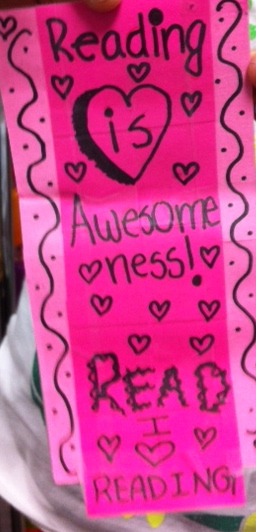
A student of mine showed me this reading bookmark that she had created recently.
The message I got when I first saw this bookmark is that teaching kids the joy of reading always has been, is currently, and always will be, the key to our work in teaching reading.  Amazing the perspective that our students can provide for us on any given day!

In the midst of how busy I am throughout a given day, I must remember these core beliefs.  There are dozens more of them.  I know that when I follow through and keep my focus, both my students and I will benefit, and we will remain motivated and encouraged as readers and writers no matter how busy we may be.