Monday, February 4, 2013

Hints Toward a Reading Life

Sometimes it is good for teachers to take a few minutes out of our day, and observe--to really observe the small things, the littlest hints, the tiny reminders that what we are doing as lovers of books is truly making a difference in the minds of our students on a daily basis.  Sometimes I question or wonder, "Am I really making a difference?"  "Do my students love books more now than they did last year?"  "Am I equipping them to become life-long learners?"

So, I've been noticing a little more lately, and observing the "small things."  None of the revelations below are necessarily new or "other-worldly," but what I've found is encouraging.


  • I see students taking books with them to every class to squeeze in some reading time.
  • Students often can't wait to tell me about another book they just finished.
  • They choose persuasive writing topics like asking an author to add another book to a current series.
  • They choose persuasive writing topics like asking teachers for more independent reading time.
  • My kiddos groan when it's time to stop independent reading.
  • My students cheer when it's time for read aloud (and complain when I stop reading).
  • It's becoming harder and harder for students to come out of "the reading zone" during independent reading.
  • They are working on strategy instruction beyond the "literal" level, and are making deep connections, revelations, and thoughtful observations about characters and events.
  • They are beginning to really "own" the idea of keeping a "Next Reads" list (not just because I tell them to keep such a list).
  • They actually read (and trust) other students' book recommendations!
  • They are seeing the value in stretching beyond their own genre comfort zones.
  • They are becoming better "previewers" of books, and are abandoning books less often.
  • Students are problem-solving words, and looking at context more meaningfully to gain understanding.
There is still a lot of teaching and learning yet in the year, but when I get a bit discouraged, or when time just seems to slip away, I know I can stop and reflect on this list, and know that it is purposeful, meaningful, and real.

Monday, January 28, 2013

Rescheduling our Plans

Picture this:  You plan a lesson thoroughly.  You've accounted for differences in your students' learning.  Resources are at the ready.  You have even rehearsed some of the dialogue of your lesson.  Enthusiasm is high.  But, before you know it, the clock shows that you have run out of time.   Really?  How in the world could the time have gone that quickly?

Rescheduling is part of life.  Personally, I've been experiencing it quite a bit with friends and other outside appointments lately.  We know it's just part of life.  It's unavoidable many times.  But in having to reschedule, we often become slightly agitated, somewhat frustrated, or even annoyed or disappointed.  After all, we've planned carefully, and, in the case of teaching, we want our kids to experience our lessons when our energies are focused and our enthusiasm is high.

So, how do we handle the reality that is rescheduling?  I am reminded again of a mantra that I am working to embrace this year more than ever.  It's the idea of "quality versus quantity."  I can become slightly uncomfortable when it appears I've "checked off" fewer activities within my reading or writing workshop, because, let's face it, when we think productive, we often think in terms of quantity.  At least I do. So, a real shift in thinking must take place in order to continue to be ready to face each day, despite any interruptions, difficulties, or rescheduling efforts that need to take place.

How does that translate in the reading/writing workshop?  For me, it involves asking essential questions like:

  • Despite the need to put off something until the next day, were kids engaged in texts?
  • Although one class of students may be "behind" another class in terms of pacing, did students learn something new today?
  • Although my mini lesson wasn't as thorough as I would have liked, did students actively add to their schema or background knowledge in some way?
  • Though kids may have had slightly less time to read or write, were they participating in these tasks in real, meaningful ways?
  • Even if the schedule needs to be altered, did kids see a love of reading and writing demonstrated in my classroom today?
Asking myself these questions, in spite of any interruptions or changes in my schedule helps me to honor my day in its own way.  After all, this is what happens in real life.  We make meaningful plans in our daily schedule.  We have purpose and reasons behind these tasks.  We make appointments and have to do lists. But, inevitably, we often don't get everything done in one day.  So, we move those tasks to the next day.  Therefore, we plan for it another time.  It's the same with our workshop time.  I need to give myself permission to be okay with this, even for the discomfort it sometimes brings.

When I am flexible enough to reschedule my plans, I can perhaps realize an even better journey the next day.  I might think of a new idea, or perhaps have a bit more time to expand on a concept or strategy, or maybe explain part of a lesson even better due to the time I had to process from the day before.  

Rescheduling is not always easy, but it's part of our busy lives as teachers. Taking it in stride is not always easy, but when I remind myself to be thoughtful and remember quality over quantity, keeping in mind the questions above, I can progress well with my students, one day at a time.

Thursday, December 13, 2012

Reflecting on Core Beliefs

My mind never seems to shut off in thinking about reading and writing instruction. As the holidays are approaching, it's a good time to refresh our thinking on some core beliefs in order to help keep a sense of focus with our students in the midst of our hectic daily schedules.  The following reflections are not original, flashy, or unique to me, but these thoughts keep coming back to me week after week, and I know that if these are truly in place, then I can rest assured that the foundation of my work is at least solid, and I can build on that foundation with other skills and learning objectives along the way.

  • Students need lots of time for reading and writing.
  • We need to promote the love of reading in everything we do throughout the day.
  • Noticing when students reflect honestly and thoughtfully about their learning is one of the greatest joys of teaching.
  • Differentiating for our students' needs is important in order to truly help them grow meaningfully.
  • Planning for differentiation takes time.  It is not a perfect process every day, and trial and error is okay, as long as we have kids' needs at the forefront.
  • Students need to have lots of choices in their reading and writing workshop.
  • Students need to be actively involved in creating reading and writing goals alongside the teacher.
  • We do not need to have parents "sign off" on reading logs each week when authentic reading habits are the goal. However, using a different tool such as reading lists can help students feel a sense of accomplishment and pride in what they've read, as well as provide a record of accountability.
  • We can help grow our kids' test scores through more reading and more writing.
  • Don't ever lose sight of the main thing:  To help kids learn to love reading and writing.  A lot.
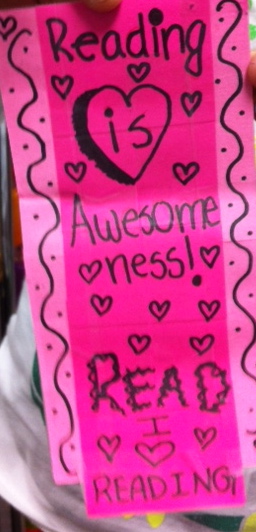
A student of mine showed me this reading bookmark that she had created recently.
The message I got when I first saw this bookmark is that teaching kids the joy of reading always has been, is currently, and always will be, the key to our work in teaching reading.  Amazing the perspective that our students can provide for us on any given day!

In the midst of how busy I am throughout a given day, I must remember these core beliefs.  There are dozens more of them.  I know that when I follow through and keep my focus, both my students and I will benefit, and we will remain motivated and encouraged as readers and writers no matter how busy we may be.

Tuesday, October 30, 2012

"Owning" the Workshop

At the beginning of the school year, it seems that in instruction within reading and writing workshop, teachers are largely the ones to "own" the learning experiences at first.  By that, I mean that we are largely the ones who are deeply aware of the objectives and purposes of each mini lesson--those several, specific, very focused lessons in the first few weeks that aim to develop our workshop in meaningful ways.  These lessons will no doubt continue throughout the school year.  We are very purposeful in the implementation of these beginning lessons, because we know that it truly sets the tone of the workshop for the entire year.  Though they vary a bit from year to year, my first few mini lessons are always centered around how we "do" things in our reading and writing classroom.  I want students to see how serious we are about the "business" of reading and writing, and these first lessons guide students' understanding and purpose.  Students can readily begin to see the "routine" of workshop, including aspects of mini lesson work, read aloud, independent reading, conferring, and so on.  Students come to understand the expectations.  They begin to follow the routines and know the daily components of workshop.

What's amazingly special to me as we come close to the end of a grading period is learning when our kids really begin to "own" the workshop for themselves.  For example, in writing workshop, we have been learning about using excellent details in our writing, and the recent mini lesson focus is on how to truly "show, not tell" in our writing pieces.  After several sessions of guided practice with this skill, students, during the "practice" phase of writing workshop, continue typing the drafts of their narrative pieces.  During some writing conference time in the past few days, students have shared with me some of their reflections as they were working on their writing.

Here are some of my "noticings" about their work thus far:


*Students are using more details to enhance their leads.


*They are including more sensory details in order to include rich language in describing people, places, and events.

*Students are more excited about wanting others to read their stories, because they see the power in using strong, vivid words.

*They are conversing with me more about the process of reading over their work several times, and finding many areas to revise in order to provide their reader with a better glimpse of their true intent for writing.

*Students are beginning to see the value in revising their work so that it is made better.  They are more aware of the reality of how authors are not finished with their work until after many revisions.

These are just a few examples of ways I've seen students really "owning" their experiences within writing workshop.  I love seeing their enthusiasm grow with this writing project.  I talked with students today regarding how critical a skill it is to learn how to include amazing details in their work.  I reinforced with them how powerful it is to "show, not tell," and that it is definitely not just a "catch phrase."  I told them that the more they learn (and practice) this skill early on, the better writers they will be.  Their future teachers will be excited about what they can already do, and they will be encouraged to take them to the next level in their writing.

Of course, there are many other essential learnings in teaching upper elementary students how to write well.  But this particular skill has resonated with my students. They love details that help them see, hear, smell, taste, and touch.  They care about how their stories sound to others.  They want others to read their pieces.

The strategy of "show, not tell" (or using vivid details, descriptive language, etc.) is so powerful.  I believe if we can "catch" or motivate more of our students in this stage of their schooling to love how writing can influence others through rich details, then we have perhaps made them writers for life.  Just as we have such passion for growing our students as readers, we can have that same hope for writing as well.


Tuesday, October 16, 2012

Finding Time for What is Important


Many people know that one of my favorite quotes of all time goes like this:

"People find time for what is important to them, no matter how busy they are."
~Carole Lewis 

This quote transcends so many areas of life, and especially so in teaching.

Today, a few former students came to visit me after school.  We were talking about our reading routines from last year, and one of the girls said, "If we just could take out all of the little routines in our daily class, we would have more time for reading." They were reflecting about how little independent reading time they had in class, and they were actively constructing different possible solutions as to what areas of their teacher's instructional class period they could change in order to gain more reading time.  I just sat, blinking hard, because I so agreed with every word they said.  It just makes sense.

It got me thinking, too.  So, what routines or procedures are we performing with our kids in class that we can simplify or eliminate in order to provide kids with more time to read?

Donalyn Miller, in The Book Whisperer, references some similar experiences when former students come back to visit and reflect on the world of reading.  She mentions the idea that while she doesn't want to become unprofessional and discuss aspects of other teachers' reading practices, it is hard not to inwardly cringe.

I think my former students have simply learned the best way to continue to grow as readers:
READ.
Yes, it is a sacrifice in some ways to carve out time for practices such as independent reading and read aloud, but these are two things that should be at the forefront of our instruction, not the first things we cut out when we are pressed for time!

I was both thrilled and disappointed when I talked with my former students this afternoon.  I was so happy to see them yearning to read; I could see they really were wanting to find some possible solutions for change.  Though I didn't feel it was my place to say anything (out of respect for colleagues), this admission on their part was proof positive that they "get it." They really understand what reading is all about.  This is enough to put a smile on my face because I realize the power of reading workshop became very real for them in past experiences through the years.  But the other part of me is disappointed, because there isn't a whole lot I can do, except encourage them to read that much more at home, even in the midst of their busy schedules.  I sure hope they do so, no matter how busy they are.

Perhaps the next time I see them, I will share the above quote with them, and hope it resonates with them, as it has with me.


Sunday, October 7, 2012

Planning (too far) Ahead?

The other day, my husband was shopping at a local retail store.  He called me in a state of disbelief, saying, "They actually have Christmas decorations out already!" It is not a new scenario, for sure, but when I thought about his observation at the store, I was a bit incredulous, thinking, "Gee, we haven't even had Halloween or Thanksgiving yet, and people are already thinking about decorating for Christmas!"

Now don't get me wrong.  I love the spirit of decorating for Christmas.  It is my favorite holiday, for more than one reason.  But jumping so far ahead already in our calendar, when we have more than two months before Christmas, just baffled me.  I kept thinking, "Why do stores always plan so far ahead?"

This observation has stuck with me for the past few days.  It was meaningful to me, and it became an analogy with which I can relate, because I think of this example in my own life as a teacher.  You see, for nearly 20 years, I have always taken time to plan an entire week's worth of lesson plans at a time, laboriously writing out every single detail in my lesson plan template a week ahead of time.  I always figured that is how it should be done.  For some teachers, they are required to submit lesson plans to an administrator, indicating their plans for the week ahead.  Though I am not required to do so in my district,  I always felt (at least initially) so ready and prepared by doing it this way.  I also felt a bit "victorious" when I finished my plans (though my head hurt a little bit from all of that planning).

The problem was, each week of teaching through the years, I found myself drawing lots of arrows on my plans from one day to another when I couldn't finish an activity with my students, or when I needed to slow down (or speed up) in my lessons in a content area.  My lesson plans were no longer neat and tidy.  And, on top of that, I found myself rewriting each day's plans on a piece of paper or sticky note, since my master lesson plan for the week was not accurate (ambitious, perhaps, but not accurate).

This year, as I was planning my first full week of instruction, it just worked out best for me to plan day-by-day.  I've found that those first few days of the school year require day-to-day planning, as the individual students in the class really do dictate how far we get in a variety of activities.  So, with a bit of trepidation, I planned my lessons day by day for the first week.  Then, I found that the process seemed to work well.  By planning my lessons one day at a time, I knew, with more precision, what I wanted to cover the next day, since logistically, I was very aware by the end of the day of what needed to be taught next in each unit of study I was teaching.  I found myself really looking forward to my planning period those first few weeks, because I was eager to write (or in my case, type) my plans in such a way that made total sense to the flow of my week.  For the past six weeks, I have not been planning out my entire week in one sitting.  Yes, I am purposeful and knowledgeable well ahead of time about the content or units I need to cover for the week in general, but in terms of the specific plan and activities for each day, I do so the day before.  It just feels much more efficient this way.  As I say in my book, Organized Teacher, Happy Classroom, "When your lesson plans are concise, creative, and well thought-out, you are well on your way toward efficiency and purpose for the long haul" (Page 120).

I don't think it's wrong for stores to set up their holiday decorations two months early.  For some customers, this is helpful for them in order to plan far enough in advance so that they are able to better plan out their shopping.  It gives them a better idea of what to do leading up to the busy holiday itself. For me, though, in planning as an educator,  I've finally found, after nearly 20 years, a system that I hope will allow me the ability to continue to be just as thoughtful, but utilize instead a method for planning that meaningfully represents what my students need each day, on their timetable, rather than on my own.

I have a lot to learn still about teaching, but I am excited about this change in planning my weekly instruction.

Now I need to begin planning for how to decorate for Halloween.  Or Thanksgiving. Or Christmas.  I think I'll stick with planning for Halloween for now.

Monday, October 1, 2012

Building on the Foundation, Part I


We're into our sixth week of school already, and I'm working on planning how to "launch" the next phase of reading workshop in my classroom.

In the first five weeks so far, it's been all about setting up reading and writing workshop in the classroom.  We've discussed routines galore.  We've had many discussions about what good readers do and how they act.

To summarize some of our class thinking thus far in Reading Workshop, I thought I'd post some pictures of our reading workshop anchor charts in order to share some workshop "foundations" for the school year.  Anchor charts are nothing new, certainly, and many teachers find the value in using them to capture student thinking and important teaching points about a variety of reading and writing routines.  

I've had teachers ask me about reusing anchor charts from year to year.  I always re-create anchor charts with students each year.  I feel it's very important to use student thinking in creating the anchor charts.  Nearly all of the writing on these anchor charts has come from student responses.  This way, students have true ownership of the learning and thinking that we've collected on these charts, and they are therefore more inclined to refer back to them as the year progresses.  After all, that is why we create these charts in the first place--to refer to and build a strong reading experience for our students.  


Ways We Choose Books
There are two anchor charts here.  The top chart is a brainstorm on the first day of school where I gathered students' thinking about the all-important question, "Why Do We Read?"  The anchor chart underneath is one we completed together several days later, entitled, "Ways We Choose Books."  This chart was inspired by Pinnell and Fountas, in their book Guiding Readers and Writers.


The anchor chart on the top of this picture captures our thinking about Reading Workshop Guidelines.  These guidelines were inspired also from Pinnell and Fountas's thinking about workshop guidelines.  The anchor chart on the bottom was from a mini lesson describing the Genre Requirements for students to read 30 books.  The "30 Book Goal" was inspired by Donalyn Miller, author of The Book Whisperer.  I love having kids set this goal, and I am so excited each year to help guide students in meeting their book goal to further their growth as readers.  Students will work toward a goal such as this, and they respond well to teachers with high expectations.

In this top anchor chart, I wanted to gather students' thoughts about what they thought good readers did on a regular basis.  This group thinking will help us to set goals and work toward behaviors that strengthen us as readers.  They brainstormed many thoughtful ideas, many of which are ones we will reinforce throughout the year.  The bottom anchor chart gives kids an understanding of their ultimate goal during independent reading time, which is to truly be in "the reading zone."  Thanks to Nancie Atwell for "coining" this term.  I love helping my kids become aware of identifying what it truly means to be in the "reading zone," and I look forward to guiding them more and more each day to becoming better and better readers.

Those are just a few of the charts on our Reading Workshop wall.  I am thrilled each day to be able to engage in conversations with my students about the books they are reading.   Though the "foundation" is overall solid, we have much more to build upon within our workshop this year, and still many more "layers" of "mortar" to place, so to speak, in order for all of the reading workshop elements to truly come together.

I'll be sharing more soon about our reading workshop anchor charts and will reflect more on how these mini lessons are a critical part of students' reading instruction for the remainder of the year.